
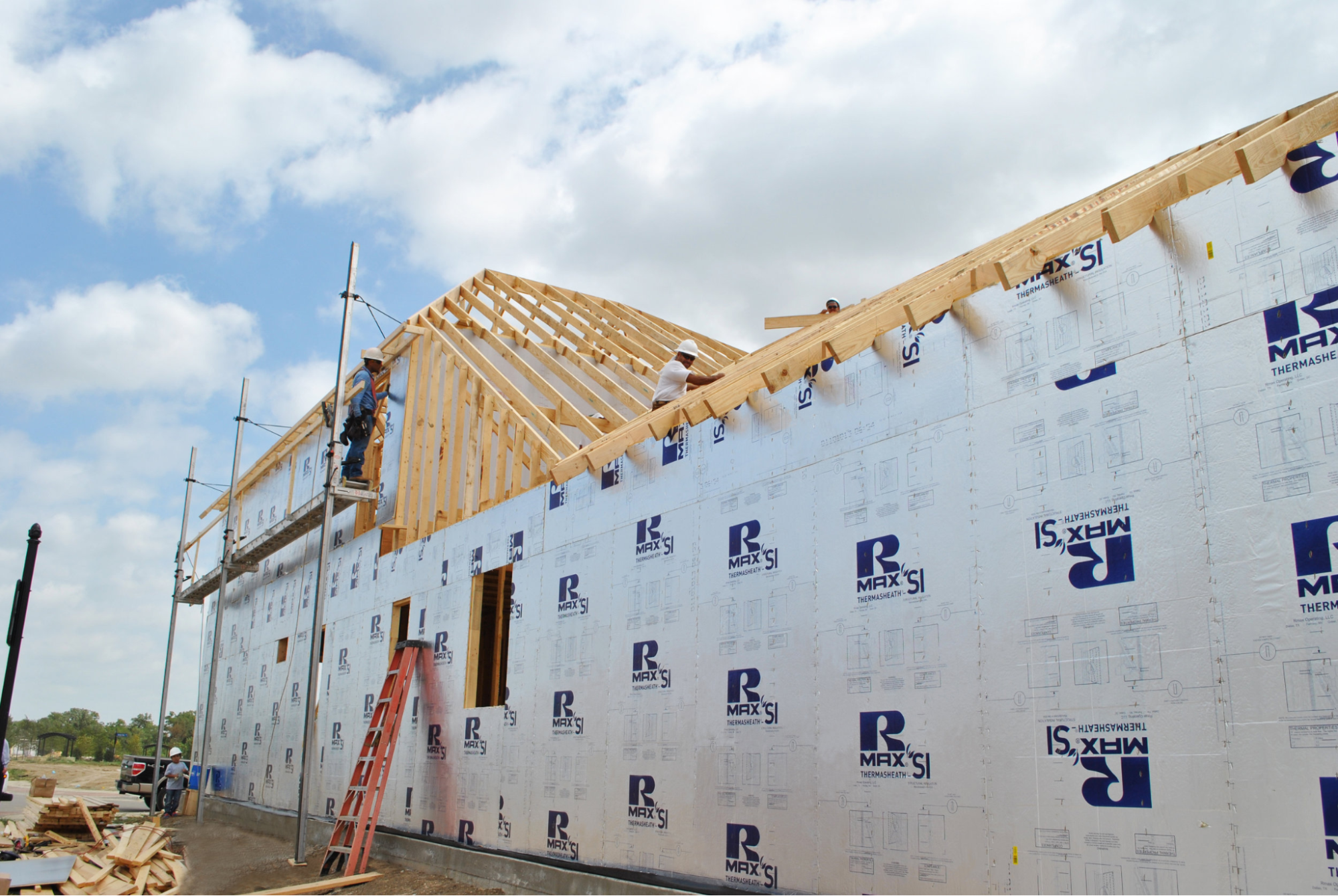
Choosing continuous insulation by nominal R-value alone can create problems elsewhere in the wall. Board thickness, vapor behavior, fire requirements, cladding support, and control-layer detailing can all change when one material is substituted for another. Below, Thermasheath is compared with XPS, EPS, and mineral wool on the points that change real wall details.
Comparing Thermasheath With Other CI Boards
Continuous insulation boards can provide the same nominal thermal target while changing other parts of the wall assembly. The XPS, EPS, and mineral wool numbers below come from Owens Corning FOAMULAR 250, Insulfoam InsulWall, and ROCKWOOL Cavityrock. Other products in each category will vary.
| Criterion | Rmax Thermasheath / Polyiso | XPS | EPS | Mineral Wool |
|---|---|---|---|---|
| Published thermal resistance at 75°F mean temperature | R-6.0 at 1 inch; R-20.3 at 3 inches | About R-5.0 per inch (FOAMULAR 250, 25 psi) | Roughly R-3.9 to R-4.6 per inch, depending on density and product type | About R-4.3 per inch (Cavityrock) |
| Approximate thickness for R-20 | 3 inches provides R-20.3 | About 4 inches | Roughly 4.3 to 5.1 inches based on published R-value per inch | About 5 inches |
| Moisture considerations | Closed-cell closed-matrix foam with very low published water absorption; foil facers create a low-perm layer | Closed-cell closed-matrix foam with low water absorption; commonly used where moisture resistance is important | Closed-cell open-matrix foam, but water absorption and other properties vary by density and product | Bonded mineral fibers, air-permeable, vapor-open and moisture resistant, but typically paired with separate water-control layers |
| Vapor permeance | Less than 0.1 perm | Product- and thickness-dependent; representative 1-inch board up to 1.1 perm | Product- and density-dependent; representative 1-inch products about 2.0 to 5.0 perms | Highly vapor permeable; current unfaced Cavityrock data list 27 perms |
| Air-control potential | Testing of board shows very low air permeance; assembly performance depends on sealed joints, penetrations, and transitions | The insulation board itself may have low air permeance, but system-specific joints and transitions must be detailed for continuity | The insulation board itself is air permeable. Systems will require a separate air-barrier material that must be detailed for continuity | Not intended to replace the air-control layer, and will require a separate air-barrier material |
| Fire considerations | Thermoset foam plastic (does not melt); use within applicable code-compliant and tested assemblies | Thermoplastic foam plastic (will melt); assembly requirements still apply | Thermoplastic foam plastic (will melt); assembly requirements still apply | Noncombustible under ASTM E136 |
| Compressive strength | 20 psi standard; 25 psi available by request; thinner boards have different published values | 25 psi for a representative Type IV product | Wide range, roughly 10 to 60 psi across representative EPS types | Not directly comparable to foam-board psi values without matching test conditions and deformation criteria. Thermoplastic foam plastic (will melt); assembly requirements still apply |
| Weight and handling | Lightweight, nominal 2.0 pcf; commonly available in large rigid boards | Lightweight rigid foam | Density varies roughly 1.0 to 3.0 pcf by representative EPS type | Denser than the foam boards; representative exterior boards are commonly supplied in smaller semi-rigid panels |
| Installation | Rigid board; edges tightly butted; joint treatment depends on intended wall function | Rigid board; can be cut and fitted in the field | Rigid board; properties and attachment needs vary with density | Semi-rigid boards require attachment compatible with the wall and cladding system |
| Strong fit | High R-value at less thickness; multifunctional in exterior walls of residential construction, where the foil-faced board provides the water-resistive, air-barrier, and thermal control-layer strategy; utilizing a low-combustibility insulation | Assemblies emphasizing moisture resistance or specific compressive requirements | Projects that can use its range of densities, strengths, and thermal values | Vapor-open assemblies, rainscreens, and designs prioritizing noncombustible insulation |
| Main tradeoff | Low vapor permeance must fit the wall's drying strategy | Lower R-value per inch than Thermasheath in the representative comparison | Usually requires greater thickness for the same nominal R-value | Lower R-value per inch increases insulation thickness for the same thermal target |
Standard Thermasheath is a foil-faced rigid insulation board used as polyiso continuous insulation across several exterior-wall construction types, including masonry and framed walls built with steel, fire-retardant-treated wood, or conventional wood studs. Of all these differences, R-value per inch is usually the first one that shows up in the wall section.
How Thermasheath Insulation Changes Wall Thickness
For exterior wall insulation, thermal resistance per inch directly affects how much assembly depth the insulation requires.
Comparing Thickness at Approximately R-20
For roughly R-20, current product data put Thermasheath at 3 inches, compared with about 4 inches of XPS, 4.3 to 5.1 inches of EPS, and about 5 inches of mineral wool. When exterior wall depth is limited, that extra inch or two carries through to fasteners, trim, and window details.
How Added Thickness Changes Wall Geometry
Additional insulation thickness, required when using lower performing insulation materials, can reshape the full wall profile. Thicker exterior insulation affects fastener length, cladding attachment geometry, window and door transitions, veneer relationships, and other enclosure details. On projects with a fixed exterior dimension, reducing insulation thickness may also help preserve usable interior space, but only when the overall wall geometry actually changes. The geometric benefit depends on which plane of the wall is constrained.
If the exterior building line, veneer line, or another outside dimension is fixed, a thinner assembly can provide greater flexibility on the interior side. If the interior finish plane is fixed instead, the benefit may appear primarily as less outward projection and simpler exterior transitions rather than additional usable floor area. When the rest of the assembly remains comparable, Thermasheath insulation can give the designer more room to meet the thermal target without adding as much exterior wall depth.
Moisture, Vapor, and Air-Control Performance
Swapping boards also changes how the wall handles water, vapor, and air.
Vapor Permeance Changes the Drying Strategy
Thermasheath uses reinforced aluminum facers and has a published water-vapor permeance below 0.1 perm. On the outside of the wall, that acts as a vapor retarder, so the wall needs to be designed to dry toward the interior.
Mineral wool sits at the other end of the spectrum. A representative ROCKWOOL Cavityrock product is highly vapor permeable, making it well suited to assemblies that are intended to dry outward. XPS and EPS fall between these examples, with permeance affected by product type and thickness.
It is important to consider that the exterior conditions, especially those related to humidity, will vary widely throughout the year. With the use of a less vapor permeable, aluminum faced, exterior continuous insulation, those fluctuations in exterior humidity are kept to the exterior of the envelope and will have far less effect on the interior side wall cavity and materials within it.
Air-Barrier Performance Depends on Detailing
The Thermasheath board itself has very low tested air permeance and is defined as an air-barrier material, but complete air-barrier performance requires continuity across joints, penetrations, transitions, and adjacent materials. Rmax also permits standard Thermasheath to serve as a prescribed WRB over wood studs when it is installed with the required joint sealing, fastening, and flashing details.
Fire Performance Requires a Material and Assembly Comparison
On fire, mineral wool and the foam boards are in two different conversations.
Material Fire Properties and Assembly Testing
Mineral wool has a clear material-level distinction because representative stone wool CI is classified as noncombustible under ASTM E136. Thermasheath, XPS, and EPS are foam plastics, so their use is governed by applicable code provisions and assembly conditions. Rmax provides NFPA 285 documentation for applicable Thermasheath wall configurations and identifies UL-listed designs that incorporate the product in fire-resistance-rated assemblies. Walls outside those documented configurations need their own review.
ASTM E84 data also need context. Surface-burning results provide material information. They do not replace assembly-level fire testing where the code requires it.
What Can Change a Tested Assembly
A tested or evaluated assembly includes more than the insulation board. Framing, exterior sheathing, insulation thickness, cladding, air spaces, interior components, and other materials can be part of the documented configuration.
Changing the insulation product, thickness, facer, or another assembly component may require the designer to confirm that the proposed wall still falls within the applicable test, engineering analysis, evaluation, or listed design.
Code Compliance Is an Assembly-Level Check
Those fire requirements sit within a broader code review. A CI selection may also need to satisfy energy-code thermal requirements, water- and air-control provisions, construction-type restrictions, attachment conditions, and product evaluation criteria.
Thermasheath has product-specific technical evaluation and NFPA 285 assembly documentation available through Rmax. The applicable documentation must match the adopted code, construction type, cladding, and wall configuration. A board with the same R-value is not automatically code-equivalent.
Strength, Weight, Handling, and Installation
These numbers matter as much to the installer as to the spec writer.
Compressive Strength and Attachment
Standard Thermasheath is listed at 20 psi compressive strength, with 25 psi available by request. Owens Corning FOAMULAR 250 provides a representative Type IV XPS comparison at 25 psi, while EPS spans a much wider range because density and product type can take representative products from roughly 10 psi to 60 psi.
The psi values are not directly comparable across every insulation material. Mineral wool compressive behavior can be reported differently; usually as psf rather than psi which indicates very low compressive value. Cladding attachment systems also depend on fastener design, girts, clips, masonry ties, substrates, wind loads, and insulation thickness.
Weight, Handling, and Field Installation
Thermasheath has a nominal overall density of 2.0 pcf and is handled as a rigid foam board. Representative EPS products range from about 1.0 to 3.0 pcf, and XPS is also installed as a lightweight rigid board. Exterior mineral wool is denser and commonly supplied in smaller semi-rigid panels; current Cavityrock products use different density constructions according to thickness.
Those physical differences affect how crews cut, position, temporarily retain, and fasten the insulation. Rigid foam can bridge across a framing plane as a board, but seams must remain tight and any joints serving an air- or water-control function require the prescribed treatment. Semi-rigid mineral wool conforms differently around minor surface irregularities, yet it normally relies on a separate air- and water-control layer behind the insulation.
How Climate Changes the CI Board Comparison
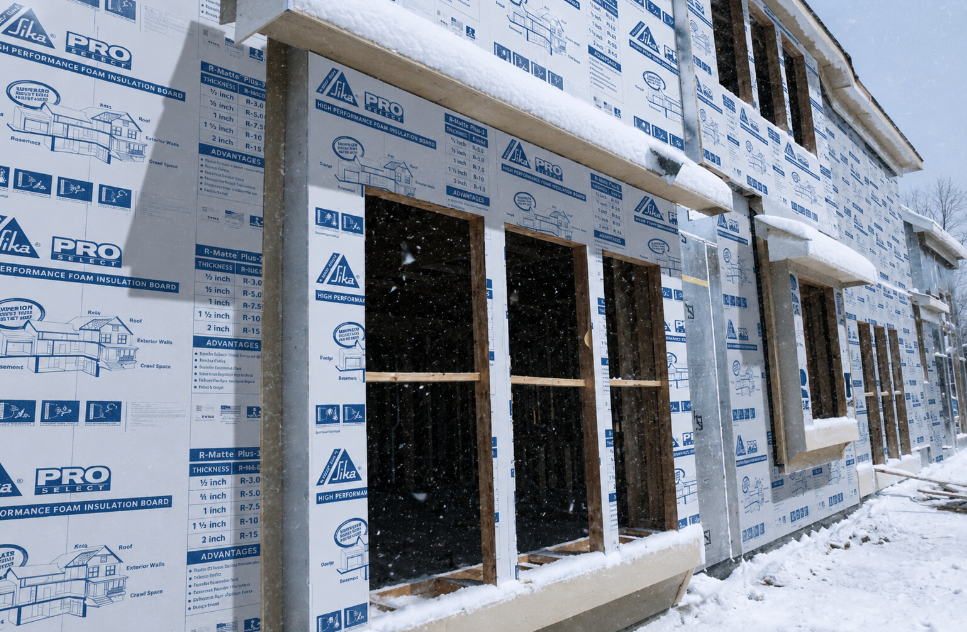
Climate changes how you should read the published numbers.
Mean Temperature and Long-Term Thermal Performance
Climate affects both thermal performance and moisture strategy. Published R-values should be read with the mean test temperature in mind, especially when a project is exposed to prolonged cold conditions.
Long-term thermal resistance, or LTTR, is a reporting method used for roof insulation products with captive blowing agents, not wall insulation products, to estimate aged thermal performance. Use current manufacturer data rather than a category-wide assumption about thermal aging.
Cold-Climate Selection
Polyiso performance at lower temperatures cannot be reduced to one universal derating number. The relationship varies with formulation and blowing-agent chemistry. Manufacturers should be consulted when design temperatures make product-specific cold-weather data important.
In cold climates, compare the selected products under equivalent conditions and evaluate the full wall's temperature and vapor profile. Moisture drive also changes with climate and occupancy, so a vapor-resistant exterior layer may fit one assembly well and complicate another.
Is Thermasheath Better Than XPS?
Thermasheath is a stronger fit when the project needs more nominal R-value within limited exterior wall thickness, but XPS can be a better fit where its moisture resistance or a particular compressive-strength option drives the specification. Owens Corning FOAMULAR 250 provides a representative XPS reference at about R-5 per inch at a 75°F mean temperature and 25 psi, compared with Thermasheath's R-6 at 1 inch and R-20.3 at 3 inches. Water absorption of XPS products and polyisocyanurate insulation products like Thermasheath have been determined to be within the same range, when tested in accordance with ASTM C272.
Vapor strategy and application can change the XPS comparison just as much as thermal resistance. Thermasheath's foil facers create a much lower-permeance layer than the representative 1-inch XPS data. Replacing one with the other can therefore change the wall's drying characteristics as well as its thickness.
Thermasheath vs. Mineral Wool
Thermasheath can reach a target nominal R-value with less exterior insulation thickness, while mineral wool offers high vapor permeability and a noncombustible insulation layer. Current ROCKWOOL Cavityrock data provide about R-4.3 per inch at 75°F and classify the product as noncombustible under ASTM E136. It is also highly vapor permeable and is not intended to replace the wall's air- or water-control layers. Thermasheath provides more thermal resistance within the same nominal thickness and can contribute to air- and water-control functions when detailed according to applicable Rmax requirements.
For a vapor-open rainscreen, mineral wool may fit the design intent well. For a thin commercial exterior wall where insulation depth is tightly constrained, Thermasheath may reduce the thickness required to reach the thermal target.
A properly designed wall assembly, including rainscreen assemblies do not require the use of vapor-open continuous insulation to function.
How Thermasheath Compares With EPS
Thermasheath generally provides more nominal thermal resistance per inch than EPS, but EPS is a broad category with properties that change substantially by density and product type. Insulfoam InsulWall XV is one high-density EPS example, at about R-4.6 per inch at 75°F and 60 psi compressive strength. Across Insulfoam's broader EPS wall-product types, thermal resistance ranges from roughly R-3.9 to R-4.6 per inch and compressive strength from roughly 10 psi to 60 psi.
That range is why you have to compare specific EPS products, not the category. A higher-density EPS board may offer much greater compressive strength than a lower-density product, yet it can still require more thickness than Thermasheath to reach the same nominal R-value. Vapor permeance and water absorption also vary by EPS type, so “EPS” should not be treated as one fixed specification.
Which CI Board Is Best for Different Applications?
Here’s where each board tends to make the most sense.
| Application Priority | Strong Candidate | Reason to Consider It | Key Qualification |
|---|---|---|---|
| Thin wall assembly | Thermasheath | High nominal R-value with less exterior thickness | Low vapor permeance must fit the wall strategy |
| Residential exterior wall | Thermasheath, mineral wool, or tested XPS/EPS systems | Several materials can work when the complete assembly is properly designed | Fire, cladding, air/water, and code requirements govern |
| Commercial exterior wall | Thermasheath, mineral wool, or tested XPS/EPS systems | Several materials can work when the complete assembly is properly designed | Fire, cladding, air/water, and code requirements govern |
| Vapor-open exterior assembly | Mineral wool | High vapor permeability supports outward drying | Separate air- and water-control layers are typically required |
| High-moisture or below-grade condition | Product approved for the specific exposure; XPS is a common option. The use of polyisocyanurate insulation below grade is becoming more common. | Closed-cell foams can provide strong moisture resistance | Below-grade or prolonged bulk-water exposure is a different selection problem from above-grade rain exposure or vapor drive |
| Fire-conscious assembly | Mineral wool where noncombustible insulation is a priority; tested foam-plastic assemblies where permitted | Material combustibility and assembly fire performance are separate criteria | Follow the applicable tested or evaluated assembly |
| Maximum R-value in limited wall depth | Thermasheath | Current Rmax data provide high nominal thermal resistance at comparatively lower thickness | Verify temperature, vapor, fire, and attachment requirements |
| Residential structural sheathing plus CI | Thermasheath-SI system | Thermasheath-SI combines polyiso insulation with a structural component for residential wood-stud construction | It is a different product from standard Thermasheath |
Rmax also offers a dedicated Thermasheath-SI Residential Solution for residential wall assemblies that need the functions addressed by that system. Standard Thermasheath remains a nonstructural board, so the two products should not be treated as interchangeable.
What to Verify Before Substituting a CI Board
Matching R-value is just the first check. Before replacing Thermasheath insulation or another specified CI product, confirm:
the R-value at the required thickness and comparable test temperature
the effect of the new thickness on cladding attachment and wall geometry
water-vapor permeance and the intended drying direction
the role of the board in the air- and water-control layers
applicable NFPA 285, fire-resistance, or other assembly requirements
compressive properties and attachment-system assumptions
substrate, fastening, joint, flashing, and transition details
climate and exposure conditions
current code reports, evaluation reports, and manufacturer limitations
sustainability documentation using comparable EPD or LCA boundaries
The broader Rmax wall products portfolio includes insulation and wall solutions for different assembly requirements. Product selection should follow full assembly compatibility, including thermal, moisture, fire, attachment, and code requirements.
Sustainability Should Be Compared on Equal Terms
Environmental comparisons should use compatible EPD functional units, product category rules, and life-cycle boundaries. Current polyiso documentation includes third-party verified wall-insulation EPDs and identifies pentane or pentane blends as blowing agents used for laminated polyiso manufactured in North America, while competing insulation categories publish their own environmental documentation.
Specifiers can compare blowing-agent impact, documented recycled content, current EPD data, the material needed to reach the same thermal target, and the life-cycle stages covered. Greater insulation thickness can increase material volume, but neither thickness nor material category alone establishes which option has the lower environmental impact.
Specify an Rmax Wall Solution Around the Assembly
Rmax’s technical team can review Thermasheath against your actual wall assembly before you finalize the spec. Contact us today to talk through your project.
Frequently Asked Questions
These questions add Thermasheath specification and installation details beyond the main material comparison.
-
Current Rmax data list R-13.1 at 2 inches and R-27.4 at 4 inches. These values are based on ASTM C518 testing at a 75°F mean temperature.
-
Rmax lists a maximum service temperature of 250°F for Thermasheath.
-
Yes. Thermasheath panels may be positioned either vertically or horizontally. The boards should meet snugly along their edges, and vertical seams need support from framing or structural sheathing.
-
Current Rmax data report water absorption below 0.2% by volume under ASTM C1763 Procedure B and a maximum of 0.3% under ASTM C272. Those values describe the product test results and do not replace proper wall drainage, flashing, or water-control detailing.