
ASTM C578 Explained: Understanding Rigid Foam Insulation Types and Requirements

Every insulation project depends on consistent performance data—and that starts with clear material standards. The ASTM C578 specification defines how rigid polystyrene insulation is manufactured, tested, and classified by strength and density. Understanding these classifications allows designers and specifiers to select materials that meet both structural and thermal demands across roofs, walls, and foundations.

What ASTM C578 Covers

The standard is the Specification for Rigid, Cellular Polystyrene Thermal Insulation. It defines property requirements for molded or extruded foam boards used in building envelopes and civil applications. The document applies to insulation operating between −65 °F and 165 °F and excludes laminated or faced products that change base performance.

  • Originally issued in 1951 and revised many times since, it sets measurable thresholds for compressive strength, density, thermal resistance, dimensional stability, water absorption, vapor permeance, and flexural strength. 

  • Manufacturers run controlled tests to prove compliance before a board can carry a specific “Type” label.

This framework promotes uniform minimum performance from one producer to the next, giving architects and contractors confidence that a specified type will meet identical minimum criteria regardless of brand.

Classification of Types

Each type in ASTM C578 corresponds to a minimum compressive strength and nominal density, establishing predictable performance benchmarks for design and field use.Higher-density types generally resist crushing and moisture intrusion better, though actual moisture behavior also depends on manufacturing process and facers and may slightly reduce R-value per inch because of reduced trapped air. Designers typically balance compressive strength against budget and application—light framing rarely needs more than Type II, while plaza decks or freezer floors may justify Type VII or IX.

Key Physical Property Requirements

Each foam type defined in the specification must meet specific property thresholds verified through testing.

  • Compressive strength: Measured at 10 % deformation to verify load capacity for roofs or foundations.

  • Thermal resistance: Typically R-3.6 to R-4.5 per inch, confirmed by ASTM C518 testing.

  • Water absorption: Many boards limit absorption to low single-digit percentages by ASTM C272; some XPS products report values as low as 0.1%.

  • Vapor permeance: Determined separately by ASTM E96

  • Dimensional stability: Most manufacturers design boards to maintain less than ~2 % change through thermal cycling, a common benchmark reflected in data sheets.

  • Flame and smoke index: Evaluated through ASTM E84 testing when required by building code or project specification; not a base requirement of the standard.

These benchmarks confirm that materials maintain mechanical and thermal integrity under load, moisture, and temperature variation. They do not guarantee system performance—installation and protection layers still determine long-term success.

Spotlight on ASTM C578 Type IV

Among all categories, ASTM C578 Type IV remains the workhorse grade. With a 25-psi compressive-strength minimum and moderate density, it balances rigidity, weight, and cost.

  • Type IV performs well in roof assemblies where insulation supports membrane loads without deformation and in below-grade walls subject to compressive and moisture stress. 

  • It also appears in protected-membrane roof systems and insulated concrete forms, where compressive resistance helps limit deformation under long-term load.

  • Most designers call it the go-to spec unless a project pushes higher loads or unusual moisture exposure. 

Its balance of strength and cost makes it the baseline EPS and XPS type for commercial and residential applications alike.

EPS vs XPS Under the Standard
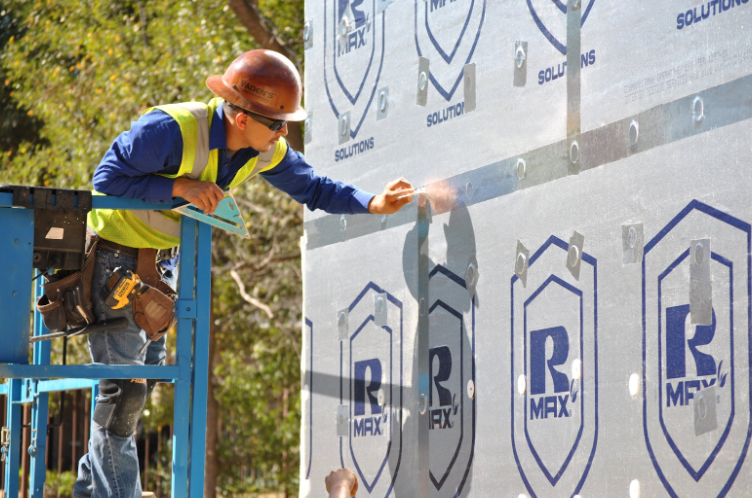
Construction worker securing rigid polystyrene insulation panels to the exterior wall of a building.

Both expanded polystyrene (EPS) and extruded polystyrene (XPS) comply with ASTM C578 but are produced differently. EPS is molded from pre-expanded beads fused in a block, producing uniform density with open cell interfaces. XPS is extruded in a continuous process, creating a tighter cell structure with lower water absorption.

Thermal Performance

XPS typically achieves around R-5 per inch, while EPS commonly ranges about R-3.6 to R-4.2, with values varying by product formulation and temperature. XPS can experience minor long-term thermal drift as blowing gases diffuse, while EPS values tend to remain more stable over time.

Moisture Behavior

XPS typically shows lower water absorption in short-term standardized tests, while field studies have found EPS can retain less long-term moisture in certain soil or freeze-thaw exposures.

Environmental Impact 

EPS uses low-GWP pentane blowing agents; new XPS formulations are transitioning to similar chemistry.

Because the specification classifies by performance rather than manufacturing method, both materials share the same type thresholds but exhibit slightly different field behavior. Designers evaluate these trade-offs in context of cost, exposure, and project requirements.

Specifying and Selecting Materials per C578

When writing or reviewing specifications, confirm these elements:

  • Type designation: Identify both material and type (e.g., “EPS Type IV insulation complying with ASTM C578”).

  • Compressive and thermal values: Use tested data, not nominal marketing values.

  • Moisture exposure: Select higher-density types for below-grade or inverted roof use.

  • Compatibility: Verify adhesive and membrane chemistry with polystyrene.

  • Fire protection: Install within rated assemblies or protect with code-approved barriers.

The standard sets the baseline; actual performance depends on installation and environmental conditions. Proper drainage and protection boards extend service life and preserve R-value over time.

Common Pitfalls and Specification Errors

Misinterpreting the requirements of the specification often leads to recurring design and installation errors that are easily avoided with careful review.

  • Assuming all EPS or XPS perform equally without testing.

  • Treating “Type” as a quality grade instead of a minimum standard.

  • Ignoring long-term creep under sustained loads.

  • Mixing solvent-based adhesives incompatible with polystyrene.

  • Using foam boards intended for thermal insulation as structural components.

Recognizing these limits keeps insulation systems reliable through their design life and avoids costly callbacks.

Where R-Max Fits into the Discussion

Construction workers on scaffolding installing rigid polystyrene insulation panels on a multi-story building exterior.

While both standards test compressive and thermal properties, polyiso often achieves among the highest R-values per inch under standard test conditions—typically around R-6 to R-6.5, though performance varies with temperature and long-term aging (LTTR).

  • It generally demonstrates better fire behavior than many EPS or XPS foams because it is a thermoset material that does not melt or drip under heat exposure. 

  • Polyiso boards are also engineered to maintain dimensional stability across a broad service-temperature range when installed in accordance with manufacturer guidance.

  • Designers commonly specify C578-compliant foams for below-grade and cold-storage applications, while choosing C1289-certified polyiso for continuous insulation in above-grade walls and roofs. 

Understanding these differences ensures balanced assemblies that meet both energy-efficiency and fire-safety objectives.

Smarter Insulation Choices Start with R-Max

R-Max engineers manufacture polyiso insulation systems tested to ASTM C1289, offering among the highest R-values per inch typical of rigid foam boards. These products help create energy-efficient building envelopes and provide reliable fire and moisture performance when installed within properly designed assemblies. Contact us today for more information.

Understanding Hydrostatic Water Pressure: How It Impacts Foundations and Building Design

Every structure interacts with water. When groundwater accumulates around a foundation or retaining wall, it exerts a steady outward force known as hydrostatic water pressure. This unseen load can compromise waterproofing layers, distort walls, and weaken the building envelope over time. Recognizing how hydrostatic water builds and behaves helps designers take control through sound engineering and tighter envelope coordination.

What Is Hydrostatic Pressure?

Hydrostatic pressure is the pressure exerted by a fluid at rest due to the weight of that fluid. In practical terms, water in the ground exerts a force against any surface that contains it. The equation P=ρghP = \rho g hP=ρgh expresses this relationship, where pressure equals water density multiplied by gravitational acceleration and the height of the water column.

It sounds minor until you spread that pressure over a full wall. Then the numbers get serious. For every foot of water depth, roughly 0.43 psi—or about 62 psf—of pressure develops. Ten feet of water can therefore create more than 4 psi, or 620 psf, on a foundation wall. That pressure adds up.

What Causes Hydrostatic Pressure to Build?

Several site and environmental factors combine to create hydrostatic water loads. 

  • High groundwater tables, impermeable clay soils, or poor surface grading prevent water from dispersing naturally. 

  • Heavy rainfall, snowmelt, or irrigation runoff can saturate the backfill and trap water along the wall.

In regions with limited drainage, even a short storm can elevate groundwater levels enough to create sustained hydrostatic water loads for days. When that water has no escape path, it exerts continuous pressure on every joint, membrane, and material layer it contacts. Capillary action moves moisture through pores, but hydrostatic pressure forces it through defects under sustained head. Even so, every assembly has to plan for the worst-case load.

How Hydrostatic Pressure Affects Walls and Foundations

Lateral pressure pushes inward on walls, creating bowing or hairline cracking. Upward pressure under slabs or footings can cause uplift and floor heave. Water infiltration through cracks or unsealed penetrations transports dissolved minerals, which crystallize as efflorescence and expand pores within concrete.

Moisture intrusion reduces insulation efficiency and can degrade adhesives or sealants not rated for submerged conditions. Understanding what hydrostatic pressure does to these assemblies is essential to designing systems that remain dry and stable for decades.

Calculating Hydrostatic Pressure in Design

In design terms, hydrostatic pressure on a wall must be considered alongside soil loads and surcharge forces. Engineers use pressure diagrams to calculate combined effects on foundations. The value increases linearly with depth, meaning that each additional foot below grade adds proportional stress.

This linear increase guides reinforcement detailing and wall thickness at the base. Waterproofing professionals likewise reference ASTM D5385, the standard test for hydrostatic head resistance, to ensure membranes and coatings can withstand realistic field conditions. These standards turn abstract physics into measurable construction criteria.

Managing Hydrostatic Water Through Design

Cross-section of basement insulation system with drainage pipe

Drainage comes first. Hydrostatic water control starts there. Footing drains, gravel backfill, and perforated piping systems remove groundwater before it accumulates. Drainage boards create a vertical path for water to travel downward instead of pressing against the wall. Proper grading at the surface diverts runoff away from foundations.

Each of these steps reduces static head and minimizes direct hydrostatic pressure on the structure. When site conditions limit drainage potential, design must assume full hydrostatic load and rely on structural and material resistance to maintain integrity.

Continuous Insulation and Moisture Barriers

Continuous insulation plays a significant role in maintaining performance under hydrostatic water exposure. R-Max polyiso insulation, with its closed-cell structure, resists moisture absorption and retains compressive strength when subjected to lateral loads.

When integrated with waterproofing membranes, it forms part of a composite barrier that both insulates and protects. Its consistent thermal resistance prevents cold-surface condensation that can amplify moisture migration. That coverage has to stay tight and continuous, or pressure finds its way in.

Thermal and Mechanical Performance Under Pressure

The relationship between hydrostatic pressure and insulation performance is both mechanical and thermal. Mechanically, water pressure increases the likelihood of joint separation or fastener movement if materials lack adequate strength. Thermally, saturated assemblies lose R-value and can accelerate freeze-thaw cycling.

By specifying rigid, closed-cell insulation that resists both compression and water intrusion, designers limit these effects. R-Max systems achieve this through dimensional stability and minimal water absorption, maintaining continuous performance even in high-moisture environments. That’s the trade-off — durability means detail.

Installation and Maintenance Best Practices

Effective hydrostatic water management extends beyond product selection. 

  • Detailing and sequencing are critical. 

  • Insulation and drainage layers should be installed before backfilling to prevent voids or membrane damage. 

  • Penetrations must be sealed with compatible materials tested for hydrostatic head.

Positive-side waterproofing, applied to the exterior face of the wall, provides direct resistance to groundwater pressure and is generally preferred for long-term durability. Where exterior access is limited, negative-side coatings may be used internally, but their performance depends heavily on substrate preparation and surface dryness.

  • Drains need routine flushing and verification, or pressure starts to creep back.

  • Settlement or hydrostatic shifts may alter groundwater pathways over time, changing load distribution on the wall. 

  • Incorporating inspection ports or accessible cleanouts allows early detection and maintenance.

Coordinating Drainage, Waterproofing, and Continuous Insulation

Managing hydrostatic pressure requires precise coordination among drainage design, waterproofing application, and continuous insulation placement. Drainage relieves pressure so membranes and structural elements carry less load, while continuous insulation maintains thermal stability under changing moisture conditions.

R-Max polyiso insulation supports this integration with closed-cell moisture resistance and high compressive strength. When drainage paths stay open, membranes remain sealed, and insulation remains continuous, the wall assembly resists both lateral water load and long-term degradation — turning hydrostatic pressure from a threat into a controlled design factor.

Specify R-Max Continuous Insulation for Moisture-Resistant Assemblies

R-Max engineers design polyiso insulation to perform as part of a complete below-grade system. Its closed-cell composition resists moisture absorption, retains high compressive strength, and maintains thermal performance under load. Integrating R-Max boards with proper drainage and waterproofing systems helps protect structural integrity for the life of the building.

Contact our technical team today for specification guidance or design assistance.

Warehouse Insulation 101: A Complete Guide for Energy-Efficient Facilities

Warehouses are notoriously difficult to insulate. Expansive roofs and tall ceilings magnify heat gain and winter losses, while constant freight movement makes stability even harder. Proper warehouse insulation addresses these challenges by lowering costs, protecting goods, and creating safer, more efficient working environments that comply with modern energy standards.

The demand for distribution space continues to rise, with millions of new square feet of warehouse construction projected nationwide. This trend makes energy performance more important than ever, as even small inefficiencies multiply across massive facilities.

Why Warehouse Insulation Matters

Warehouses consume large volumes of conditioned air. Without proper insulation, temperature swings lead to condensation, wasted energy, and uncomfortable working conditions. Effective insulation lowers utility bills, improves sustainability outcomes, and protects stored products from humidity or extreme heat.

Metal Building Design Challenges

Most warehouses are built with sheet metal panels over steel I-beam frames, a design that conducts heat rapidly and provides little inherent thermal resistance. Without added insulation, these structures become thermally inefficient shells that leak energy year-round.

Energy Codes and Compliance Requirements

Compliance is another driver. IECC and ASHRAE standards set minimum R-values for different climate zones, and noncompliance results in higher operating costs and potential inspection failures. For builders, specifying insulation aligned with these codes ensures projects move forward without delay. For owners, it delivers predictable performance and reduced long-term expenses.

Moisture and Condensation Risks

Metal buildings are especially vulnerable to condensation—particularly in humid or mixed-humid climates and where ventilation or vapor control is inadequate.

How Condensation Forms in Warehouses

When warm interior air meets a cool roof deck or wall panel, water droplets form inside the structure. Over time this “sweating” drips onto products, corrodes steel racking, and damages packaging. In some cases, it supports mold growth that creates health and liability risks.

Why Continuous Insulation Is Critical

A continuous insulation system with vapor control reduces this exposure. Continuous exterior insulation interrupts thermal bridging and resists condensation, while cavity insulation alone cannot achieve the same performance in metal structures. In particular, studs and girts act as thermal bridges that create direct pathways for heat to bypass cavity insulation, making continuous coverage critical.

Added Protection with Polyiso Systems

Polyiso boards with protective facers provide both moisture resistance and thermal performance, making them well-suited for warehouses facing seasonal humidity swings. Proper insulation also helps seal pathways that rodents and insects might otherwise exploit, protecting both inventory and structural integrity.

Types of Warehouse Insulation Materials

Different insulation materials perform in different ways, and each carries specific advantages and limitations.

Fiberglass

Fiberglass batts are widely used due to their low cost. However, they require careful installation and moisture protection or their performance quickly degrades. Typical fiberglass batts provide an R-value of roughly 2.9–4.3 per inch.

Mineral Wool

Mineral wool offers strong fire resistance and sound absorption. It is durable but heavier than other options, which makes installation across large spans more labor-intensive.

Spray Foam

Spray-applied polyurethane provides strong R-values and seals against air infiltration. Its drawback is cost and application difficulty in large, open ceiling areas. Professional installation is often required to meet code. Closed-cell spray foam typically delivers between R-3.7 and R-6.5 per inch.

Polyiso Panels

Rigid polyiso boards, such as those from Rmax, combine high thermal efficiency with lightweight installation. These panels resist moisture, perform consistently across climate zones, and carry low environmental impact. Contractors often select polyiso when insulation must deliver both performance and efficiency.

Polyiso also carries third-party thermal performance certification, performs well in fire testing, and remains stable across a wide temperature range. Its low water absorption and vapor transmission make it a durable option for demanding warehouse conditions, while its high R-value per inch allows thinner assemblies to meet code with less material.

Cost Considerations and Payback

While fiberglass or spray foam may appear cheaper at first, lifecycle costs tell a different story. Polyiso’s efficiency, lower labor costs, and durability often result in better value over the life of a warehouse.

For distribution centers that operate 24/7, even small improvements in energy performance can save thousands of dollars annually. 

  • For illustration, a 50,000 sq ft warehouse in a typical U.S. climate can see five-figure annual energy differences between poorly insulated and well-insulated assemblies; actual savings vary by climate zone, energy prices, and hours of operation. 

  • Over time, those savings outweigh initial price differences. 

Owners and facility managers increasingly prioritize total cost of ownership, which makes specifying insulation with long-term benefits a straightforward choice.

Roof and Ceiling Insulation in Warehouses

The roof and ceiling are where most energy loss occurs. Without warehouse roof insulation, heat quickly builds up in summer and escapes in winter.

For suspended systems, warehouse ceiling insulation helps stabilize working conditions and reduce HVAC demand. In facilities with office buildouts, commercial warehouse ceiling insulation creates a barrier between conditioned office space and open storage areas, improving comfort and reducing noise.

Industrial and Specialized Applications

Manufacturing facilities and high-humidity operations require tailored approaches. Using polyiso as insulation for warehouse ceiling assemblies provides high R-values without adding weight. In harsher settings, industrial ceiling insulation systems with protective facers limit moisture buildup and extend service life.

Across these applications, choosing insulation that meets code while streamlining installation ensures consistent results.

Walls, Doors, and Floor Assemblies

Walls and floor systems also play important roles in thermal performance. Metal wall assemblies conduct heat rapidly unless covered with continuous insulation. Dock doors are another weak point, and insulated wall systems help reduce this loss. Even slab edges need attention — insulating the perimeter prevents cold spots and limits condensation near ground level.

By thinking of insulation as a system that includes walls, roof, and floor, owners ensure the envelope functions as one continuous protective barrier.

Facility-Specific Needs

Not every warehouse operates the same way, and insulation must reflect those differences. 

  • Cold storage facilities require high R-values and precise continuity to prevent frost buildup. 

  • E-commerce fulfillment centers combine dense racking with mezzanine offices, so insulation must perform for both open warehouse areas and traditional workspaces. 

  • Manufacturing warehouses contend with both outdoor swings and internal heat loads.

In each scenario, specifying warehouse insulation tailored to the facility reduces operational costs and ensures reliable long-term performance.

Energy Savings and Sustainability

Heating and cooling are among the largest operational expenses in commercial warehouses. Even modest improvements in insulation can lower energy demand significantly. Polyiso generally delivers higher R-values per inch than other rigid insulation types, which means equivalent performance with less material.

This matters in roof assemblies where load limits or available space constrain design. By exceeding code minimums, facilities not only lower energy expenses but also prepare for future regulatory requirements. Reduced demand also cuts carbon emissions, allowing companies to demonstrate progress on sustainability initiatives.

Installation and Safety Considerations

Efficiency is not only about energy performance but also installation. Contractors face compressed schedules and must coordinate around mechanical systems and roof work. Lightweight polyiso boards allow crews to cover large areas quickly, reducing labor hours and minimizing disruption.

Attention to details like vapor barriers and fire ratings ensures assemblies meet NFPA and IBC standards. Polyiso systems, when combined with protective facers or coatings, offer durability in demanding environments. They support safety, and they last.

Protect Your Facility Long-Term with Rmax Warehouse Insulation

Rmax manufactures polyiso insulation systems designed for warehouse environments. Our products balance high R-value performance with moisture resistance and straightforward installation. Contact us today for more information.