

Every building loses energy somewhere. Heat moves through framing, ceilings, and joints faster than most owners realize, driving up utility costs and carbon emissions. Installing energy efficient insulation is the single most effective way to control that loss, and in practical terms, it’s where measurable savings start.
Why Energy Efficiency Starts with the Building Envelope
The building envelope controls how well a structure holds conditioned air. Every discontinuity in insulation or air sealing becomes a bridge for heat and moisture, forcing HVAC equipment to cycle longer and harder. Continuous insulation, especially energy efficient insulation such as Rmax polyiso rigid boards, wraps the structure in an uninterrupted thermal layer that blocks conduction while reflective facers limit radiant transfer when installed adjacent to an air space.
Even small penetrations at sill plates or corners can reduce efficiency, which is why detailing and sealant continuity matter as much as insulation type. Properly installed, polyiso systems help meet IECC and ASHRAE 90.1 performance targets without enlarging wall cavities.
How to Specify for Maximum Energy Savings
Energy performance begins with accurate specification, not just insulation thickness. Professionals should move through four steps before selecting a product:
Audit the envelope. A blower-door or infrared scan reveals where air and heat escape. Addressing these leaks before insulating ensures real gains.
Identify climate-zone R-value targets. The IECC typically requires cavity insulation combined with continuous insulation in colder zones; confirm exact values in the edition adopted locally.
Select assemblies by exposure. Roofs and below-grade walls require continuous insulation with low permeance; framed walls need materials compatible with vapor retarders and sheathing.
Detail installation. Use mechanical fasteners rated for the substrate, stagger board joints, and tape or seal seams to preserve continuity.
Following these steps ensures that energy efficient insulation performs to its rated potential. Air-sealing combined with insulation can reduce heating and cooling energy use by about 15 percent according to ENERGY STAR data.
Comparing Energy-Saving Insulation Materials
Competitor guides often list “best insulation types,” but few quantify performance differences. The table below summarizes common materials using publicly available DOE and manufacturer data.
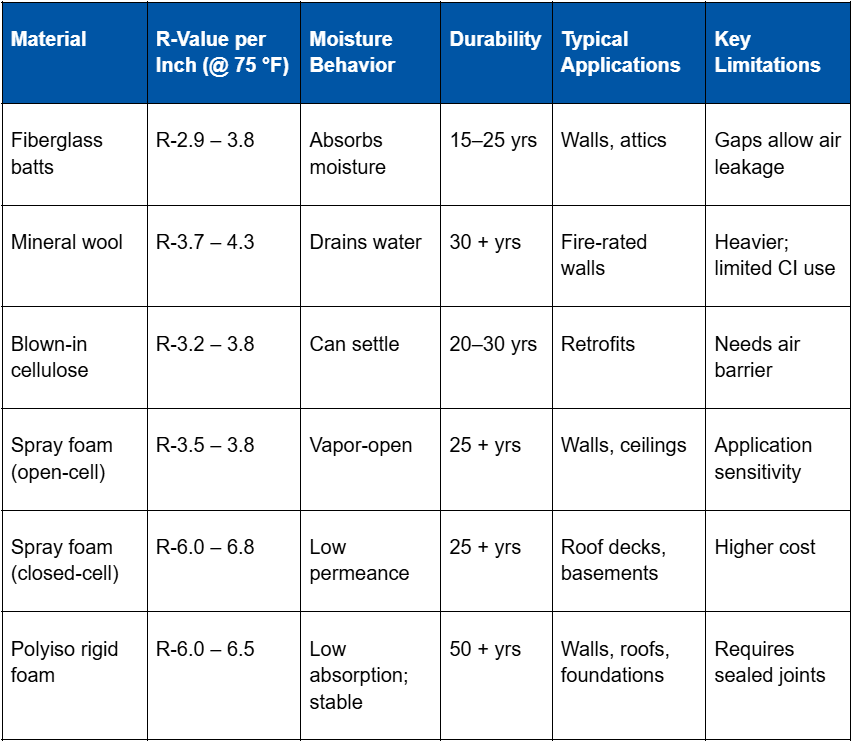
Fiberglass and cellulose remain economical but allow air movement that degrades thermal value. Spray foams deliver strong air sealing but require precise temperature and substrate control during application. Energy efficient insulation based on polyiso achieves comparable air resistance without the same environmental trade-offs, while providing the best R-value per inch and long-term dimensional stability.
Energy-Efficient Insulation for Attics and Roofs
The roof and attic assembly form the building’s top boundary—where interior heat loss and exterior heat gain meet head-on. Managing this exchange is key to maintaining comfort and reducing long-term energy demand.
Heat Loss and Solar Gain in Roof Assemblies
After walls, the roof and attic assembly are the most significant paths for energy loss. Warm air rises and escapes through ceiling penetrations while solar radiation drives heat gain from above. Without a continuous thermal layer, those forces combine to raise HVAC loads and shorten roof-system life.
Polyiso Performance in Attic and Roof Applications
To solve these challenges, designers often specify energy efficient insulation made from Rmax polyiso boards installed above or below roof sheathing. The material forms a continuous barrier that resists heat flow in both directions.
In unvented attics, polyiso keeps interior surfaces above the dew point, preventing condensation and mold. On commercial or low-slope roofs, its closed-cell structure provides consistent compressive strength, a minimum of 20 psi per ASTM D1621, supporting membranes, ballast, and light foot traffic without deformation.
Reflective Facers and Thermal Efficiency
The aluminum facers on Rmax boards lower surface temperatures and reduce radiant heat transfer across the roof deck. In hot or mixed climates, this reflective performance helps stabilize interior comfort and reduce cooling demand during peak hours.
Documented Energy Savings
According to DOE field data, properly insulating and air-sealing attics can reduce heating and cooling energy use by up to 20 percent. That improvement typically recovers installation costs within a few seasons while maintaining balanced temperature and humidity throughout the building.
Environmental and Economic Payback
Every insulation choice affects not only how a building performs but also how it impacts the environment over time. Energy savings, manufacturing inputs, and material longevity all contribute to the total sustainability profile of an insulation system.
Low Environmental Impact Materials
Rmax polyiso insulation is formulated with third-generation blowing agents that have zero ozone-depletion potential (ODP) and zero global-warming potential (GWP), minimizing environmental impact compared to legacy HFC systems. The facers contain recycled materials, and Rmax notes recycled content within its manufacturing stream to further reduce embodied energy.
Because polyiso achieves a higher R-value per inch than other rigid foams, designers can meet thermal targets using thinner assemblies and less material, which directly lowers embodied carbon. The reduced volume also means fewer truckloads, shorter transport distances, and a smaller overall jobsite footprint.
Proven Lifecycle and Carbon Performance
Lifecycle assessments referenced by Rmax show that the energy used to produce polyiso is typically recovered within the first year of service through reduced heating and cooling demand. Over time, the material’s high thermal efficiency, long service life, and low-GWP chemistry contribute to measurable reductions in operational carbon emissions. Combined with its durability and moisture resistance, these qualities make Rmax polyiso an environmentally responsible insulation choice that supports both immediate performance goals and long-term sustainability commitments.
Climate Zone Considerations
Insulation strategy changes with climate. In energy efficient insulation design, matching vapor control and R-value to local temperature and humidity is essential.
Cold climates (Zones 6–8): Prioritize high R-value and airtightness. Polyiso exterior continuous insulation limits condensation within framing cavities.
Mixed climates (Zones 3–5): Balance heating and cooling needs. Combining polyiso CI with air barriers manages vapor diffusion and drying potential.
Hot-humid climates (Zones 1–2): Moisture and radiant heat dominate. Foil-faced polyiso above roof decks or walls blocks vapor drive and reduces solar gain.
Polyiso’s versatility across all U.S. climate zones makes it a reliable material for maintaining thermal efficiency in changing weather conditions.
Choosing Rmax for Energy-Efficient Design
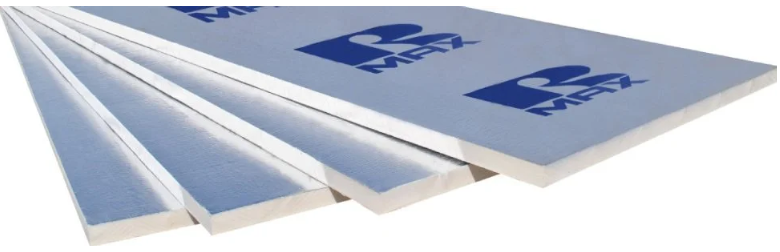
Rmax manufactures a comprehensive line of polyiso boards for walls, roofs, and exposed-interior applications, each designed to integrate cleanly into energy efficient insulation assemblies.
Thermasheath® — Aluminum-faced polyiso board for the building envelope (exterior walls, wood/steel studs, exterior ducting). Closed-cell core bonded to reinforced aluminum facers. Ideal where a foil facer and high R-per-inch are desired.
Durasheath® — Non-metallic, inorganic polymer–coated glass fiber mat facers for projects that do not want foil facers (e.g., under stucco, cavity and masonry walls, re-siding). Designed for durability and building-envelope use.
ECOMAXci® FR — Exterior wall continuous-insulation board with glass-fiber–reinforced aluminum facers; tested to UL 1715/NFPA 286 for use without a separate thermal barrier in specific conditions. Available for exposed/interior and CI wall applications.
TSX-8510 — Exposed-interior CI board (white acrylic coated facer on the exposed side) tested per UL 1715/NFPA 286, used where an interior finish surface is required without an additional thermal barrier per listing.
R-Matte® Plus-3 (Sika® Rmax® Pro Select) — Residential sheathing/retrofit board with reinforced aluminum facers, supported by application guides for stud walls, attics/crawl spaces, stucco, and select roof deck overlays. Widely available at retail.
Each of these products is supported by Rmax data sheets and application guides that reference ASTM C1289 classifications and relevant fire tests; verify thickness, LTTR, and use-conditions against the latest document set for your jurisdiction and assembly.
Design with Confidence Using Rmax Polyiso
Rmax designs and produces insulation systems built for long-term efficiency and code compliance. Each board is tested for thermal resistance, moisture durability, and compatibility with wall and roof assemblies. Contact our technical team today for specification support or project-specific design assistance.