
Every building envelope leaks under pressure. When those boundaries allow uncontrolled airflow, efficiency, comfort, and durability all decline. Properly air sealing exterior walls prevents air movement through framing joints, penetrations, and sheathing seams—issues that otherwise lead to energy loss and hidden moisture damage. A complete air-sealing plan connects structure, insulation, and mechanical design into a single sealed assembly.
Why Air Sealing Exterior Walls Matters
Air sealing exterior walls directly affects a building’s energy use, comfort, and long-term durability. The following sections explain how pressure control and code testing translate those goals into measurable results.
Pressure, Stack Effect, and Energy Loss
Air pressure moves through every gap in a wall assembly. Pressure differences—amplified by the stack effect, drive air through cracks and joints. Warm air escapes through upper floors while drawing unconditioned air through lower walls, wasting conditioned energy. Addressing those leakage paths early in construction is far simpler than repairing them after finishes go up, which is why air sealing new construction is now a core energy-code requirement.
Code Limits and Testing Benchmarks
Air-tightness requirements define how much air a building may leak under test pressure. These thresholds quantify what “tight construction” means in measurable terms.
Residential Limits
Under the 2021 IECC R402.4, blower-door testing (ASTM E779) is mandatory. The limit is 3 ACH₅₀ in Climate Zones 3–8 and 5 ACH₅₀ in Zones 1–2.
Commercial Benchmarks
Commercial projects following ASHRAE 90.1-2019 may pursue a whole-building test path with ≤ 0.40 cfm/ft² @ 75 Pa (or ≤ 0.60 cfm/ft² with diagnostics). Addendum t tightens certain thresholds to 0.30/0.45 cfm/ft². Field calculations often divide CFM₅₀ by 10 to estimate the equivalent leakage area (EqLA) in square inches—roughly 10 cfm per in² at 50 Pa under test conditions.
7 Effective Air Sealing Strategies
Seven interconnected strategies form the backbone of a continuous air-barrier system. Each one targets a distinct leakage path and ties back into the overall wall assembly for measurable results.
1. Use Continuous Exterior Sheathing as an Air Barrier
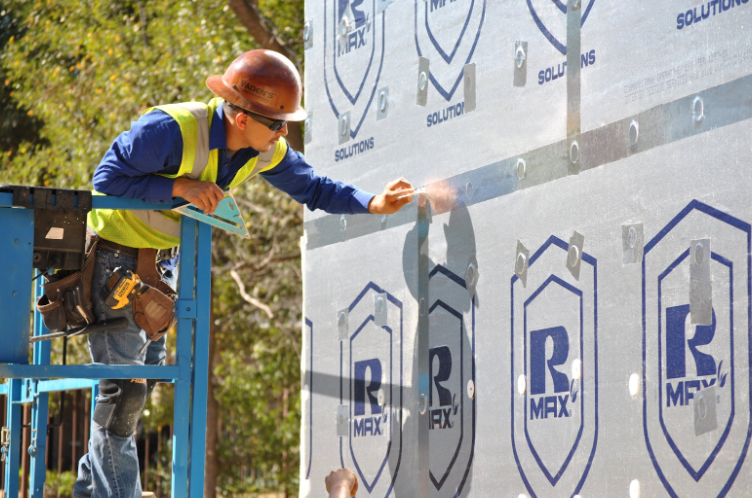
Foil-faced polyisocyanurate panels can serve as both insulation and airtight sheathing when joints and fasteners are properly sealed. Taped seams and sealed edges create a rigid plane that resists airflow and thermal bridging. Unlike interior membranes that are easily damaged once finishes go up, exterior sheathing remains visible for inspection before cladding is applied. Proper fastening and sequencing help prevent punctures during siding installation and keep the air barrier continuous.
2. Seal Framing Transitions and Top Plates
Wall-to-ceiling joints and rim-joist interfaces are major leakage points. Compressible gaskets or acoustical sealant between plates and framing members stop bypass airflow at structural intersections. During air sealing a house, complete this step before drywall or attic insulation conceals the area. Sequencing matters—late trades should never reopen sealed joints.
3. Control Mechanical and Electrical Penetrations
Every pipe or wire that cuts through the wall is a leak waiting to happen. Effective wall sealing means isolating each penetration with compatible materials: high-temperature sealants around vents, flexible boots for irregular shapes, and backer rods to control caulk depth. Crews inspect seams and penetrations before cladding goes up; smoke or infrared checks during testing catch anything missed.
4. Tape and Flash Sheathing Joints
Use tapes and flashings that comply with AAMA 711 (self-adhered flashing for fenestration) and/or ICC-ES AC148 (flexible flashing acceptance criteria). Review ASTM D3330 peel-adhesion data to confirm long-term durability. When paired with foil-faced sheathing, these products create a monolithic surface. Apply pressure with a roller to activate adhesives fully, and use liquid flashing at corners or complex junctions in accordance with AAMA 714. Consistent tape adhesion is one of the most critical details in any air sealing insulation approach because failed joints often cause the majority of measured leakage.
5. Integrate Air Sealing with Insulation
Integrating air sealing exterior walls with insulation unites airtightness and thermal control. A continuous layer of rigid polyiso outside framing interrupts thermal bridges and closes microscopic gaps between studs and finishes. Its closed-cell structure blocks air and moisture, keeping insulation at full R-value even under pressure. Treating air sealing exterior walls as part of the insulation process yields higher efficiency and steadier comfort.
6. Manage Openings Around Windows and Doors
These openings experience movement and temperature swings that test any seal. Use backer rods and low-expansion foam between frames and rough openings, then tie durable flashing tape into the sheathing plane. Liquid-applied flashing should conform to AAMA 714; stretchable tapes can bridge irregular corners without tearing. Continuous connection is the goal—every window perimeter must link to the surrounding air-barrier layer.
7. Verify and Test Performance
Air sealing techniques succeed only when verified. Crews perform ASTM E779 blower-door tests to measure leakage and visualize flow with smoke. Some projects also use ASTM E2357 chamber tests to evaluate air-barrier assembly performance before installation. These results document compliance with IECC R402.4 and provide feedback for design refinements and crew training.
Code and Climate Considerations
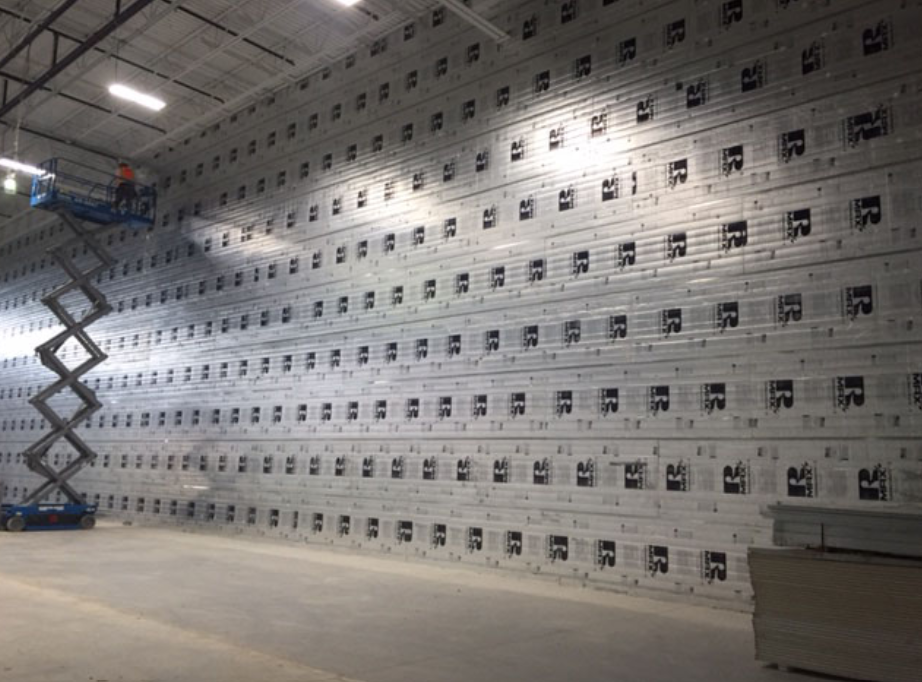
Climate determines where the primary air-barrier layer should sit within the wall. In cold zones, exterior air barriers stop warm, moist interior air from condensing inside insulation. In hot-humid regions, they block outdoor humidity from entering conditioned spaces. IECC Chapter 4 lists climate-specific vapor-retarder guidance, but the guiding rule remains continuity.
Placement by Climate Zone
In cold climates, the air barrier is typically placed toward the warm side of the insulation to prevent interior moisture from reaching cold surfaces. In hot-humid or mixed climates, the barrier shifts outward to prevent humid exterior air from entering the conditioned space. Understanding this placement is important to prevent interstitial condensation and long-term material degradation.
Material Selection and Polyiso Performance
To satisfy these requirements, designers often specify materials that control both air and vapor transmission. Rmax Thermasheath® lists water-vapor permeance < 0.1 perm (ASTM E96) and air permeance < 0.02 L/(s·m²) (ASTM E2178), making the polyiso board suitable for assemblies that must manage heat and moisture simultaneously. Designing air sealing exterior walls for local conditions ensures year-round thermal and moisture balance.
Long-Term Performance and Maintenance
Longevity depends on stable materials and inspection discipline.
Tapes must resist creep and sealants accommodate movement while exposed surfaces retain UV protection until cladding covers them.
Regular walk-throughs let owners spot joints that have started to fail before they spread.
If new penetrations occur, repair crews should replicate original detailing—clean substrate, compatible primer, sealed patch—to preserve the continuous barrier. Properly installed, air sealing exterior walls can perform for decades with minimal upkeep.
Enhance Building Performance with Rmax Air Barrier Systems
Rmax polyiso sheathing and tape systems deliver airtight performance that meets IECC and ASHRAE 90.1 requirements while improving energy efficiency. Each solution is engineered for durability, moisture resistance, and long-term thermal continuity. Contact us today for more information.