
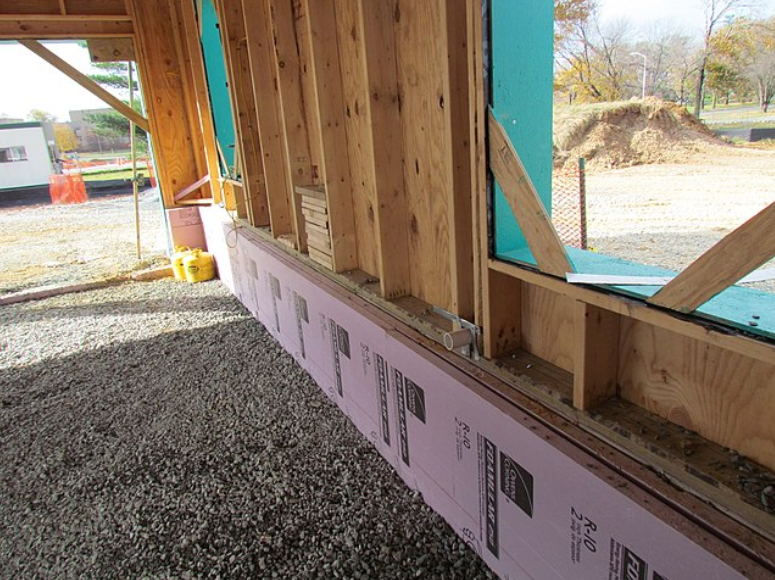
When comparing XPS vs EPS vs Polyiso below grade, there is no universal winner. The right board for foundation walls and slabs depends on moisture exposure, compressive demand, in-service thermal behavior, and how much thickness the assembly can afford. Nominal R-value still matters. Below grade, though, cold soil, groundwater exposure, backfill pressure, and transition detailing can carry more weight than the label alone.
What Changes Once the Insulation Moves Below Grade
Below-grade insulation works under a different set of pressures than above-grade continuous insulation.
Wall and Slab Demands
Below-grade insulation is not working in the same environment as above-grade continuous insulation. Soil contact changes the moisture profile. Ground temperatures stay steadier than outdoor air, but they also keep buried insulation in prolonged cold conditions in many regions, which is why below-grade material choice has to be evaluated by installed performance instead of label value alone.
Foundation walls and under-slab details do not stress insulation the same way. Wall details have to manage drainage, waterproofing continuity, and backfill pressure, while slab details add higher compressive expectations and different interface requirements with the vapor retarder and concrete layer.
Installed Performance Below Grade
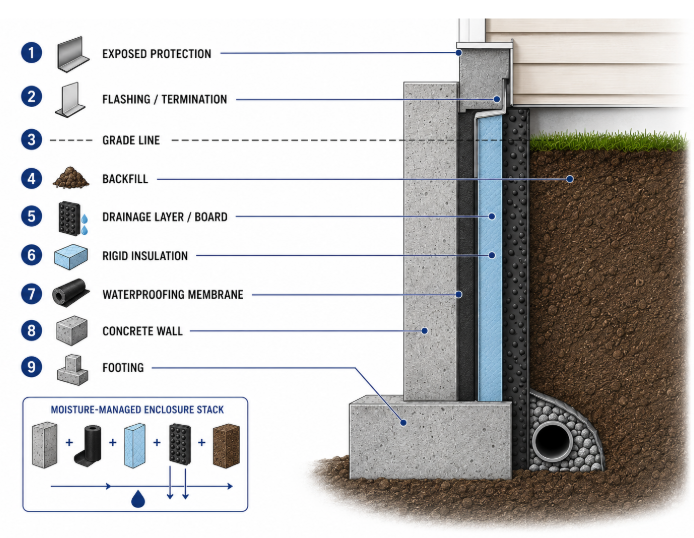
Foundation assemblies combine thermal and moisture-control roles, so the insulation has to work as part of a larger enclosure strategy. Climate, building design, and foundation type all affect the detail, while below-grade and basement-wall installations still have to account for waterproofing, drainage, freeze-thaw exposure, and protection of exposed sections rather than treating those conditions as secondary issues. Those conditions are what make a below-grade insulation comparison more dependent on installed behavior than on published board values alone.
How to Evaluate XPS vs EPS vs Polyiso Below Grade
Below grade, the comparison is driven less by category labels and more by how each board behaves in service.
Thermal Performance and R-Value Retention
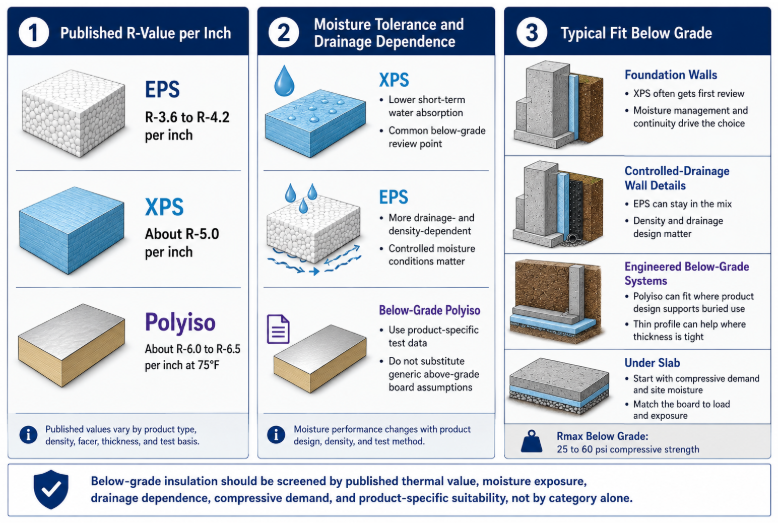
Published comparison values vary by product type, density, facer, thickness, and test basis. In broad terms, EPS commonly falls around R-3.6 to R-4.2 per inch depending on the product, XPS is commonly published around R-5.0 per inch, and polyiso wall products are commonly published around R-6.0 to R-6.5 per inch at 75°F depending on product construction and facer. That gives polyiso the thinnest profile for a given published R-value, which matters when thickness limits are tight at a foundation transition or an exterior condition needs more thermal resistance without growing the wall too much.
Below grade, though, published board value is not the whole story. Polyiso can show reduced measured R-value under sustained uniform cold exposure, while XPS performs reliably in cold and below-grade conditions. A polyiso insulation vs XPS comparison becomes more important when sustained cold exposure starts separating published board values from in-service behavior.
EPS fit note: EPS still belongs in the discussion where long-term thermal stability matters and the assembly has room for more thickness.
Moisture Exposure and Water Absorption
In below-grade assemblies, moisture exposure is one of the main factors pushing the specification toward XPS. Its closed-cell structure helps limit water penetration and supports strength and durability in cold and buried conditions. The boards also differ in water-vapor behavior, which affects how each layer interacts with adjacent enclosure components and how the assembly manages drying potential.
EPS note: EPS vs XPS insulation becomes a more useful comparison than a simple price or published R-value check once density, drainage, and moisture exposure enter the specification. A drained exterior foundation wall with good waterproofing and controlled loads can support EPS, while higher-load or more moisture-exposed conditions make EPS selection a grade- and density-dependent decision.
Polyiso note: Standard above-grade assumptions do not automatically carry over below grade. Exterior-grade polyiso products can include drainage support, moisture protection, soil-exposure resistance, and freeze-thaw performance, which is very different from treating any generic polyiso board as interchangeable in a buried assembly. Below-grade suitability depends not only on the foam core, but also on facer selection, product construction, and intended exposure.
Compressive Strength and Long-Term Durability
Once moisture exposure is accounted for, the next screening question is how much load the insulation has to carry without losing fit or stability. Below-grade walls and slabs do not ask the same thing of the insulation. Wall boards have to tolerate backfill pressure and stay dimensionally stable against the foundation surface, while under slabs the insulation has to sit under a load-bearing assembly where compressive performance matters from the start.
Load changes the equation. XPS is commonly favored when compressive strength and moisture resistance need to live together in one board. EPS can also work when the chosen product has the right density and load rating for the application, but it should not be treated as one single performance category. Polyiso remains an option when the product is intended for a specific use and the assembly benefits from higher published R-value per inch, yet its suitability still depends on board design, facer compatibility, and service conditions below grade.
The table below turns the rigid foam insulation comparison into a quick reference for below-grade decisions.
| Material | Typical Published R-Value Per Inch | Moisture Profile | Load / Compression Profile | Where It Fits Best Below Grade | Main Caution |
|---|---|---|---|---|---|
| EPS | ~R-3.6 to R-4.2, depending on type and density | More dependent on drainage and assembly control | Must be selected by density and load requirement | Budget-conscious walls, some below-grade details with controlled moisture and adequate thickness | Lower published R-value per inch and broader variation by product |
| XPS | ~R-5.0 | Strong moisture resistance for cold and below-grade conditions | Common choice where moisture resistance and compressive performance both matter | Exterior foundation walls, slab-edge details, many under-slab uses | Lower published R-value per inch than polyiso |
| Polyiso | ~R-6.0 to R-6.5 at 75°F, depending on product and facer | Product-specific below-grade suitability; engineered below-grade options add drainage and moisture protection | Product-dependent; attractive where thickness efficiency matters | Space-constrained assemblies, engineered below-grade systems, exterior wall conditions tied to the right product | Cold-temperature derating and product/facer suitability must be checked |
These are general published comparison ranges and profiles, not a substitute for product-specific submittal review.
Foundation Walls and Under-Slab Conditions Should Not Be Specified the Same Way
The same material can look very different once the assembly shifts from a wall to a slab.
Foundation Wall Priorities
Below-grade foundation walls usually push the insulation decision toward moisture management, drainage continuity, and interface control at the waterproofing layer.
For exterior foundation walls, the decision usually starts with moisture management and thermal continuity. That leads many projects toward XPS, or toward below-grade polyiso systems that are engineered to protect the waterproofing layer while resisting soil exposure and freeze-thaw conditions.
A polyiso vs XPS material comparison becomes more useful here when service conditions, product construction, and assembly fit start driving the specification more than nominal R-value alone. EPS can still be specified, but the wall detail has to be more explicit about drainage, thickness, and product grade, which means the insulation choice has to be reviewed alongside the waterproofing layer, drainage plane, and expected moisture exposure rather than as a standalone board decision.
Under-Slab Priorities
Under-slab details put more emphasis on compression, dimensional stability, and how the insulation works with the vapor retarder and slab assembly. Moisture still matters, but the screening process tightens quickly once the board is expected to stay stable under load.
Polyiso, EPS, and XPS can all appear in load-bearing slab layers, but that does not eliminate the need to match the board to the slab load and the site moisture profile. For many slab assemblies, that keeps XPS and higher-density EPS in stronger positions.
Climate-Zone Guidance for Below-Grade Insulation Choices
After wall and slab roles are separated, climate adds another layer by changing how cold exposure, moisture, and thickness constraints weigh against each other in xps vs eps vs polyiso below grade decisions. XPS performs reliably in cold and below-grade conditions, while polyiso’s measured R-value can dip under sustained cold exposure. That does not remove polyiso from the specification. It means colder regions demand more care in how the board is used and where it sits in the assembly. Cold exposure is only part of it, because site moisture, space constraints, and compressive demand can still change the ranking fast.
| Climate / Condition | General Screening Direction | Why |
|---|---|---|
| IECC Climate Zones 5–8 | XPS often deserves first review for many buried wall details | More predictable cold-condition performance in below-grade use |
| IECC Climate Zone 4 | XPS or EPS may both stay in the initial mix depending on thickness, budget, and density requirements | The assembly may not need the same cold-performance margin |
| IECC Climate Zones 1–3 | Polyiso may deserve stronger review where the product is intended for below-grade use | Higher published R-value per inch can reduce assembly thickness |
| High-moisture sites or aggressive groundwater conditions | XPS or engineered below-grade polyiso systems usually deserve closer review | Moisture management and product suitability become dominant |
| Under-slab conditions in any climate | Start with compression and moisture, then compare thermal value | Structural demand can outrank nominal thermal advantage |
This chart is general design-direction guidance, not a code rule. Final selection still depends on the product's tested properties, the waterproofing strategy, the load path, and the details at terminations and transitions.
Installation Details Often Decide Whether the Board Performs
Even the right board can underperform if the below-grade detailing is weak.
Moisture Control and Detailing
The installation sequence matters as much as the foam type. A below-grade assembly still needs excavation to the footing, a waterproof membrane on the foundation wall, tight insulation installation, and protection of exposed sections above grade.
That is also where eps vs polyiso insulation and xps vs eps insulation decisions become more specific. EPS needs a cleaner drainage and moisture-control story. XPS usually gives more tolerance in cold and damp below-grade conditions. Polyiso needs confirmation that the exact product, facer, and below-grade detailing are intended for the use rather than borrowed from an above-grade wall specification.
When Thickness Changes the Decision
When thickness is tight, polyiso’s higher published R-value per inch becomes more useful. In wet, buried, and prolonged cold conditions, that advantage may carry less weight than moisture performance and product suitability. The assembly should be detailed around the dominant jobsite condition, not around the board with the highest number on a comparison chart.
How to Choose the Right Board for the Assembly
The final screen should follow the assembly conditions rather than a generic product ranking.
For specifiers narrowing xps vs eps vs polyiso below grade, the first question is what the assembly will expose the board to, not which product category looks strongest in a broad comparison. Start by identifying whether the insulation is serving a foundation wall or a slab. Then review the main screening points below.
Assembly role: confirm whether the insulation is serving a foundation wall, slab edge, or under-slab condition.
Moisture exposure: check drainage, groundwater risk, and how the wall or slab detail manages drying.
Compressive demand: verify whether the board has to resist backfill pressure, slab loading, or both.
Thickness limits: determine whether the detail is tight enough for higher published R-value per inch to change the specification.
Product-specific suitability: confirm that the exact board, facer, and intended exposure match the assembly conditions.
If the priority is a conservative specification for cold and damp foundation conditions, XPS often remains a strong fit because it performs reliably below grade. If the project can accept more thickness and is carefully detailed for drainage, EPS remains a viable option. If the design is pursuing a more published R-value per inch or using a product engineered for below-grade polyiso use, polyiso can work, but the specification has to stay product-aware and temperature-aware. The best specification is usually the one matched most closely to the assembly’s long-term exposure, load, and thickness limits.
Choose Rmax Below Grade Insulation for Thickness-Efficient Below-Grade Assemblies
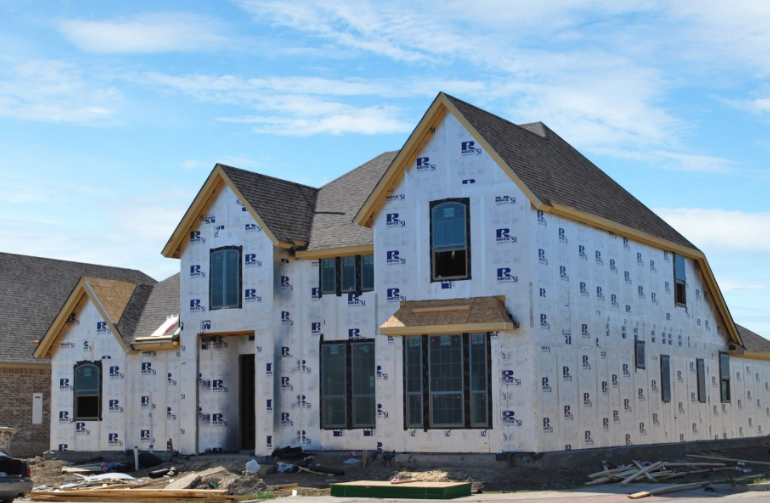
Rmax Below Grade insulation and protection board is designed for below-grade exterior walls, blind-side walls, under slab, and slab on grade where the detail calls for a polyiso-core product built for soil-side exposure and interface protection. Selection should still be tied to moisture conditions, facer compatibility, and the role the insulation plays in the wall or slab detail. Contact us today for more information.
FAQ
-
XPS is often reviewed first because below-grade foundation walls place more pressure on moisture resistance, drainage continuity, and cold-condition performance. That does not make it the automatic winner in every assembly, but it often stays near the top of the initial screening process.
-
Yes, but EPS below grade is a more product-specific decision. Density, drainage conditions, moisture exposure, and load requirements all matter more once the board is placed against a buried wall or under a slab.
-
Polyiso becomes more attractive when the assembly is tight on thickness and the product is designed for below-grade exposure. The specification still has to verify product construction, facer compatibility, and intended use instead of assuming an above-grade board can be carried into a buried condition.
-
Yes. Moisture can shift the decision quickly because buried assemblies do not behave like above-grade walls. Once drainage, groundwater exposure, and drying potential are part of the detail, moisture performance can outweigh a simple published R-value comparison.
-
Not always. Foundation walls usually place more emphasis on moisture management and continuity at the waterproofing layer, while under-slab details tighten the screening process around compressive demand, dimensional stability, and site moisture conditions.