

Exterior wall assemblies sit at the intersection of fire risk, energy performance, and code compliance. When combustible materials are incorporated into exterior walls, building codes rely on standardized fire testing to evaluate how those assemblies behave under severe fire exposure. NFPA 285 requirements address that condition by measuring how a complete exterior wall assembly responds under controlled interior and exterior fire exposure conditions.
What NFPA 285 Evaluates And Why It Exists
This large-scale, multi-story fire test evaluates the vertical and lateral spread of fire within exterior wall assemblies that include combustible components. Rather than isolating a single product, the evaluation examines how multiple exterior wall components interact as a system under conditions that simulate a post-flashover interior fire venting through a window opening. That system-level focus explains why this evaluation occupies a distinct role alongside other fire tests that address individual material properties.
When NFPA 285 Requirements Apply
Understanding NFPA 285 requirements starts with recognizing when the test applies. The standard is referenced by the International Building Code and related model codes under specific construction conditions when combustible materials are incorporated into exterior wall assemblies of certain construction types, heights, and occupancies.
Applicability turns on how the exterior wall is designed, how materials are layered, and how those components interact within the assembly, not simply on the presence of a single combustible element.
How The Test Is Conducted
The evaluation is performed on exterior wall assemblies constructed to reflect field installation. The assembly is built on a two-story apparatus with a window opening at the lower level.
Burners inside the compartment simulate a post-flashover interior fire that vents outward through the window opening, while additional burner exposure is applied to the exterior face of the wall. Instrumentation and visual observations track temperature rise, flame propagation, and fire spread throughout the assembly over the prescribed test duration.
Why Tested Wall Assemblies Are Configuration-Specific
Because the evaluation examines assemblies as installed systems, results remain specific to the tested configuration. Insulation type and thickness, air and water barrier placement, cladding materials, attachment methods, and interface detailing all influence fire behavior.
Change any one of those variables and heat transfer or flame spread pathways can shift, which is why NFPA 285 wall assemblies cannot be treated as interchangeable based solely on similar material lists.
How Performance Is Evaluated
NFPA 285 performance evaluation focuses on how fire conditions propagate through a complete exterior wall assembly during testing, providing a basis for assessing vertical and lateral fire spread under controlled exposure.
Pass–Fail Performance Intent
Pass–fail criteria are structured to limit fire spread both vertically and laterally within the wall assembly and into the story above. Temperature conditions and flame propagation boundaries are evaluated at defined locations using a combination of instrumentation and visual observation to control concealed fire spread and restrict vertical flame movement.
In mid-rise and high-rise construction, where exterior wall failures can escalate quickly, those outcomes matter.
Pass/Fail At A Glance
NFPA 285 establishes defined performance limits that assemblies must remain within during the full test duration. These limits address flame propagation along the exterior surface, fire spread within concealed spaces, and temperature conditions at monitored locations above and adjacent to the fire exposure zone.
Compliance is determined by whether the tested assembly stays within those prescribed boundaries throughout the test, not by isolated material behavior. The specific acceptance criteria are defined within the NFPA 285 standard and form the basis for pass–fail determination during laboratory evaluation.
What Compliance Really Means
Meeting NFPA 285 requirements indicates that a tested assembly performed within defined limits under controlled fire exposure. The result reflects how the full system behaved during testing rather than assigning fire resistance characteristics to individual materials.
When materials are combined into an exterior wall assembly, their interaction shapes ignition potential, flame travel, and heat accumulation in ways isolated tests cannot predict.
Wall Assembly Compliance And Approval
Compliance and approval are evaluated through a documentation-driven review process that distinguishes demonstrated test performance from jurisdictional acceptance of a proposed exterior wall assembly.
Compliant Wall Assemblies In Practice
In specifications and submittals, assemblies are often described as compliant based on documentation that demonstrates alignment with a tested configuration. NFPA 285 compliant wall assemblies are supported by full-scale test reports or accepted analytical methods showing equivalent system behavior.
Compliance rests on documented evidence and evaluation, not assumptions drawn from individual component performance.
Approved Wall Assemblies And AHJ Review
Approval follows a defined review sequence rather than occurring automatically. NFPA 285 approved wall assemblies are those reviewed and accepted by the authority having jurisdiction based on submitted test data, engineering analysis, and project-specific conditions.
In practice, that sequence moves from testing or analysis to documentation review and then to AHJ acceptance, reinforcing the assembly-level focus at each step.
Exterior Wall Components And System Behavior
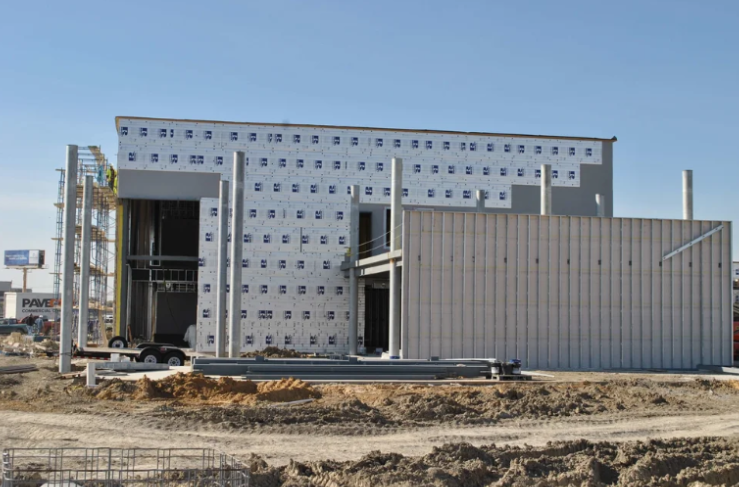
Exterior wall fire performance is governed by how individual components interact within the assembly, influencing heat transfer paths, flame spread potential, and concealed space behavior during fire exposure.
The Role Of Exterior Wall Components In Fire Performance
Exterior wall components directly influence how assemblies perform during testing. Insulation, sheathing, air barriers, water-resistive barriers, and cladding systems affect how heat and flame move through the wall.
Their arrangement governs whether fire is contained, redirected, or allowed to spread within concealed cavities or across stories.
High-Performance Wall Design And NFPA 285
As building designs pursue higher thermal efficiency, NFPA 285 requirements have become increasingly relevant. Many modern high-performance assemblies rely on materials that can introduce combustibility while improving energy performance.
This testing framework allows those assemblies to be evaluated under realistic fire exposure conditions when system behavior can be demonstrated.
Engineering Judgment And Alternative Compliance Pathways
Engineering judgment provides a limited, analysis-based pathway for evaluating specific deviations from tested assemblies when supported by existing fire performance data and subject to authority review.
Engineering Judgment And NFPA 285A
In certain situations, engineering judgment may be used to evaluate limited variations of previously tested assemblies. Often referred to in industry practice as “NFPA 285A,” this approach applies established fire performance data and engineering principles to assess whether a proposed change remains within the behavioral envelope of existing test results.
Engineering judgment functions as an extension of testing data and does not replace required testing. All such evaluations remain subject to AHJ acceptance.
When Engineering Judgment Is Appropriate
Engineering judgment is typically appropriate when changes are narrow in scope and do not introduce new fire spread mechanisms. Minor dimensional adjustments or component substitutions with demonstrated equivalence may be evaluated through this process.
Assemblies that introduce new materials, altered sequencing, or significantly different configurations generally require additional testing to establish compliance.
In The Context Of Broader Code Requirements
This evaluation is applied alongside other fire and life safety provisions, requiring test results to be interpreted within the broader code framework governing exterior wall performance.
Within The Broader Fire And Life Safety Framework
Passing the test does not remove the need to satisfy other applicable code provisions such as fire-resistance ratings or interior finish requirements. Those provisions work together to manage risk across multiple building systems.
Common Misinterpretations Of Test Data
Misinterpretation still occurs when tested configurations are assumed to allow unrestricted material substitution. Results must be evaluated in the context of the complete assembly, including attachment methods and adjacent materials.
Only then can reviewers determine whether a proposed design aligns with tested performance.
Design Coordination And Documentation Best Practices
Effective coordination depends on aligning design decisions with documentation and review requirements early enough to support predictable approval timelines.
Addressing NFPA 285 Early In The Design Process
Addressing NFPA 285 requirements early in the design process reduces coordination challenges later. Evaluating wall assemblies during schematic design or early design development aligns material selection with available testing and applicable code triggers.
This timing helps avoid late-stage redesigns and review delays.
Documentation And Review Considerations
Clear documentation supports efficient review and approval. Test reports, engineering analyses, and assembly descriptions should clearly identify tested configurations and any deviations.
That clarity allows reviewers to evaluate compliance consistently and efficiently.
Why NFPA 285 Remains Central To Exterior Wall Safety

As exterior wall systems continue to evolve, this evaluation remains an important tool for managing fire performance at the system level. By evaluating assemblies under severe fire exposure, the test provides a consistent framework for balancing fire safety with modern building performance goals.
Ultimately, NFPA 285 requirements establish a method for understanding how exterior wall assemblies behave during fire events. They support informed design decisions, clearer specifications, and predictable approval processes by focusing on system behavior rather than isolated material properties.
Get Technical Support For NFPA 285–Evaluated Wall Assemblies From Rmax
Rmax supports design teams with rigid insulation solutions evaluated within tested exterior wall assemblies. Our technical resources help clarify tested configurations, documentation requirements, and how insulation integrates with air barriers, sheathing, and cladding systems. Contact us today for more information.