

Foam board insulation performance depends on panel thickness, R-value, joint treatment, air control, and moisture management. Seams, transitions, and penetrations determine whether a continuous insulation layer behaves as designed once exposed to temperature fluctuations and seasonal humidity. Professionals evaluating the best tape for foam board insulation focus on adhesion reliability, substrate compatibility, and durability under real jobsite conditions.
Why Tape Selection Directly Affects Insulation Performance
Seams between rigid insulation boards create predictable discontinuities in the enclosure. These joints interrupt the air barrier, expose panel edges to moisture migration, and introduce pathways for convective heat loss. Tape bridges those transitions, maintaining continuity where fastening systems alone cannot provide environmental control.
Air leakage at insulation seams alters thermal performance. Moisture intrusion at panel joints affects dimensional stability. Small failures compound over time, leading to measurable efficiency losses and potential substrate damage.
How Tape Supports Air And Moisture Control Layers
Rigid foam insulation often functions within assemblies designed to regulate airflow and vapor diffusion. Tape becomes the interface that maintains continuity between adjacent boards and across transitions to sheathing, framing, or adjacent membranes.
Air barrier systems require uninterrupted seals. Vapor control strategies rely on predictable permeability. Tape properties influence whether the wall assembly manages drying, moisture distribution, and pressure differentials as intended.
Tape Categories Used With Foam Board Insulation
Adhesive chemistry and backing construction define tape behavior after installation. Selecting the best tape for foam board insulation requires understanding how different categories perform across environmental exposures and substrate conditions.
Acrylic Adhesive Construction Tapes
Acrylic systems are widely specified for long-term stability. These tapes maintain adhesion across broad temperature ranges and resist embrittlement during thermal cycling.
Acrylic adhesives age predictably. They retain flexibility longer than many rubber-based alternatives. This characteristic becomes critical where assemblies experience seasonal expansion and contraction.
Foil-Faced Tapes
Foil tapes are commonly paired with foil-faced polyiso insulation. Backing compatibility improves adhesion, while the metallic layer resists UV degradation and supports dimensional stability.
Foil constructions typically offer high tensile strength. They also perform well where low permeance at seam locations is required.
Rubber-Based Adhesive Tapes
Rubber adhesive systems provide aggressive initial tack. They bond quickly to challenging surfaces but may exhibit reduced stability under sustained heat or UV exposure.
These tapes can perform adequately within protected assemblies. Extended high-temperature exposure may accelerate adhesive creep or degradation.
Butyl And Hybrid Adhesive Tapes
Butyl formulations are valued for moisture resistance and conformability. Hybrid systems combine acrylic durability with enhanced initial tack, offering a balance between installation ease and aging performance.
Substrate Compatibility Considerations
Adhesion success depends heavily on surface characteristics. Installers choosing the best tape for foam board insulation must evaluate facer composition, texture, cleanliness, and surface energy before selecting a seam treatment strategy.
| Substrate / Surface | Adhesion Behavior | Primary Risks | Installation Notes |
|---|---|---|---|
| Foil-Faced Polyiso | High adhesion reliability due to smooth facer | Surface contamination | Clean surface ensures consistent bond |
| Fiberglass-Faced Polyiso | Texture limits adhesive contact | Incomplete pressure activation | Requires firm roller pressure |
| EPS / XPS Boards | Lower surface energy, variable textures | Reduced wet-out in cold conditions | Cold-weather-rated tape recommended |
| OSB / Plywood | Irregular, dusty surface | Edge lift, bonding inconsistency | Surface cleaning critical |
| Concrete / CMU | Mineral surface, possible moisture vapor release | Adhesive degradation if moisture present | Moisture-tolerant adhesive preferred |
| Metal Framing / Flashing | Smooth but may include coatings | Contamination / coating incompatibility | Verify surface cleanliness |
Environmental And Jobsite Conditions
The installation environment significantly influences tape performance and long-term seal reliability. Temperature during application affects adhesive wet-out because cold substrates reduce adhesive flow and bonding strength, while elevated surface heat from solar exposure may challenge adhesive stability and accelerate creep in lower-grade products.
Humidity and condensation introduce additional risks since moisture films interfere with direct adhesive contact and compromise bond formation. Temporary UV exposure prior to cladding further stresses seam materials, requiring UV-stable backing and adhesive systems to prevent degradation when assemblies remain uncovered.
Performance Metrics Professionals Evaluate
Installers comparing adhesion data and backing durability often rely on measurable benchmarks when selecting the best tape for foam board insulation. Peel adhesion (ASTM D3330) evaluates bond strength under static removal forces, shear strength (ASTM D3654) measures resistance to sliding stresses at panel joints, and tensile strength (ASTM D3759) reflects backing durability under mechanical strain.
Elongation characteristics indicate how well a tape accommodates dimensional movement within the assembly, while permeance (ASTM E96) becomes relevant where vapor control continuity is critical at sealed joints.
Application And Adhesion Best Practices
Installation technique remains the dominant factor in seam durability, regardless of tape selection.
1. Surface Preparation
Substrates must be clean, dry, and free from dust, frost, oils, or release agents. High-performance tapes fail when applied over contaminants.
2. Pressure Activation
Pressure-sensitive adhesives require firm application pressure. Mechanical rollers improve adhesive wet-out and bond consistency. Hand pressure alone may be insufficient on textured facers.
3. Alignment And Wrinkle Prevention
Wrinkles and fish-mouths create localized stress points. Flat, continuous contact ensures uniform load distribution along seams.
4. Overlap And Seam Sequencing
Tape overlaps should follow manufacturer guidance. Sequencing relative to WRBs and flashings influences drainage and water-shedding behavior.
Long-Term Durability Considerations
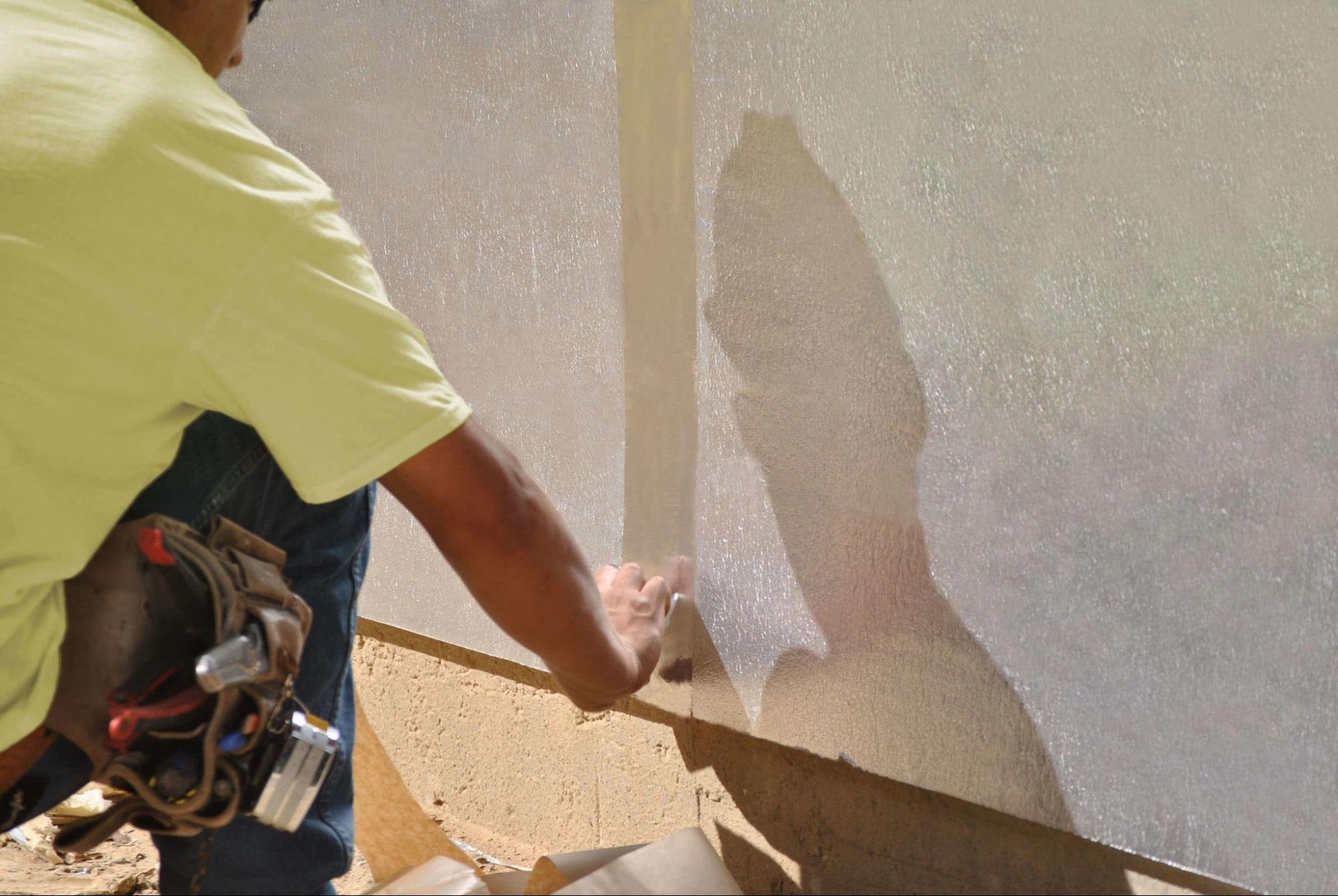
The best tape for foam board insulation maintains adhesion through thermal cycles, humidity variation, and building movement. Adhesive creep reduces seal integrity. Backing embrittlement leads to cracking. UV degradation weakens exposed seams. Durability depends on adhesive stability, backing resilience, and compatibility with environmental exposure.
Recognizing And Preventing Tape Failures
Common field failures include edge lift, adhesive separation, backing cracks, and blistering. These issues frequently trace back to surface contamination, insufficient pressure activation, improper temperature conditions, or incompatible tape selection. Inspection during installation reduces rework. Early correction prevents systemic seam failures.
Selecting A Tape Designed For Rigid Insulation Assemblies
Construction tapes engineered specifically for foam board applications provide predictable adhesion and durability. Seam integrity depends on adhesive stability, backing flexibility, and compatibility with insulation facers, which is why installers frequently specify materials such as R-SEAL Construction Tape for rigid insulation joints and transitions.
Compatibility with insulation surfaces, resistance to aging, and stability across temperature fluctuations define performance outcomes. Tape selection ultimately determines whether rigid insulation performs as a continuous control layer or behaves as a segmented component vulnerable to air and moisture leakage. Adhesion reliability, substrate compatibility, environmental tolerance, and durability must align with project conditions when identifying the best tape for foam board insulation.
Specify Rmax Construction Accessories For Reliable Seam Performance
Rmax engineers insulation and accessory products designed for integrated envelope assemblies. R-SEAL Construction Tape delivers dependable adhesion across compatible rigid foam substrates and maintains performance under demanding environmental conditions. Contact us today for more information.
As an industry leader in insulation products since 1978, Rmax stays on top to bring better products and accessories to builders as technology and codes change. Check out our full line of accessories which includes tapes, clips, and anchors. We help your projects run smoothly by providing solutions that make the job easier.
If you need expertise in matching the right product to your project, contact your local Rmax representative today.